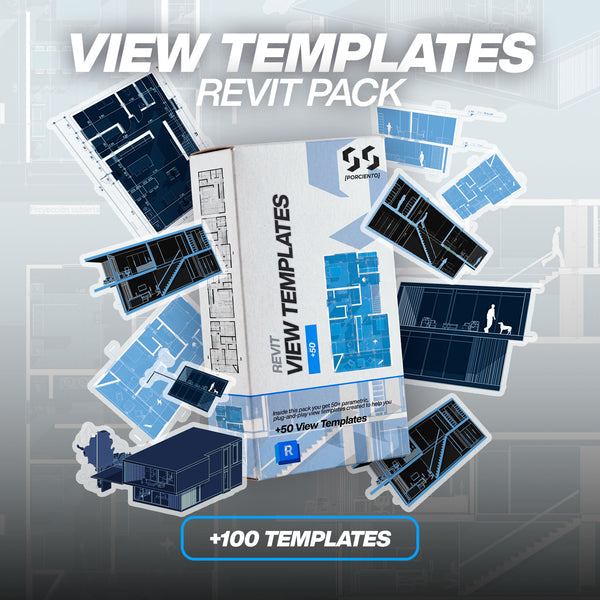
If you have ever spent hours manually adjusting line weights, visibility settings, and graphic overrides view by view in Revit, you know the pain. Whether you are racing against the clock for a final university jury or trying to maintain an architecture firm's profitability before a client deadline, doing repetitive graphic tasks is the quickest way to burn out.
Revit View Templates are the ultimate solution: they allow you to define a set of graphic standards once and apply them instantly across unlimited views. This guide covers everything you need to know about creating, managing, and using View Templates to dramatically accelerate your BIM workflow.

What Are View Templates?
A View Template in Revit is a saved collection of view properties, including scale, detail level, visibility/graphics overrides, model display settings, annotation crop regions, and more.
When applied to a view, the template enforces all its settings, ensuring consistency across your entire drawing set. Think of them as style presets for your architectural documentation. Instead of telling Revit "hide this category, change this line weight, and turn on shadows" over and over, you simply apply a template that does it all in one second.

Why View Templates Are Critical for Your Workflow
Relying on manual graphic adjustments is a beginner's mistake. Here is why top-tier students and industry-leading firms mandate the use of View Templates:
- Consistency: Every floor plan, section, and elevation follows the same graphic standards automatically. No more mismatched drawings in your portfolio or construction sets.
- Speed: Apply complex graphic settings with a single click instead of adjusting 20+ parameters manually. Reclaim hours of sleep before a delivery.
- Collaboration: Group members or office teams produce identical-looking drawings regardless of individual preferences.
- Quality Control: BIM managers (or project leaders) can lock templates to prevent unauthorized graphic changes.
- Scalability: Transfer templates between projects to maintain personal or office-wide standards.
Head-to-Head Comparison: Manual Workflow vs. View Templates
| Feature | Manual Graphic Overrides | Revit View Templates |
| Setup Time per View | 5-15 minutes | < 5 seconds |
| Project Consistency | Low (Prone to human error) | 100% Guaranteed |
| Updating Standards | Requires changing every view one by one | Change the template once, all views update |
| Collaboration | Messy (Everyone has their own style) | Standardized and unified |
| Best For | One-off quick conceptual studies | Final studio deliverables and professional documentation |
Essential View Templates Everyone Should Have
Based on industry best practices and real-world experience, here are the View Templates every practice and design studio should create and maintain:
Architectural Floor Plans
- Presentation Floor Plan: Color-filled rooms, furniture visible, landscape elements shown. Used for client presentations and academic juries.
- Working Floor Plan: Black and white, all annotations visible, reference planes shown. Used for daily design work.
- Technical/Permit Floor Plan: Simplified graphics, code-compliant annotations, area calculations visible. Used for regulatory submissions.

Sections and Elevations
-
Building Section (Presentation): Material hatches, entourage, sky background, shadows enabled.
- Building Section (Construction): Detailed hatches, dimension strings, detail callouts, grid lines.
- Exterior Elevation: Material surfaces, shadow casting, grade line, window schedule marks.

Specialized Templates
- Reflected Ceiling Plan: Ceiling grid, lighting fixtures, HVAC diffusers, sprinklers visible.
- Site Plan: Topography, landscape, parking, setback lines, property boundaries.
How to Create and Transfer View Templates
Creating a Template
- Step 1: Configure a view exactly how you want it, including all visibility, graphics, scale, and display settings.
- Step 2: Go to View > View Templates > Create Template from Current View.
- Step 3: Name your template with a clear naming convention (e.g., 'ARCH-Floor Plan-Presentation-1:100').
- Step 4: In the template properties dialog, check which parameters should be controlled by the template and which should remain independent per view.
- Step 5: Apply the template to other views via the Properties palette.
Transferring Between Projects
One of the most powerful features is the ability to transfer View Templates between projects. Go to Manage > Transfer Project Standards, select the source project, check only 'View Templates', and click Transfer. It is highly recommended to keep a master template file (.RTE) that contains all your standard View Templates, families, and settings.
Pre-Built View Template Packs: Saving Hundreds of Hours
Creating View Templates from scratch requires extensive knowledge of Revit's graphic system and a significant time investment.